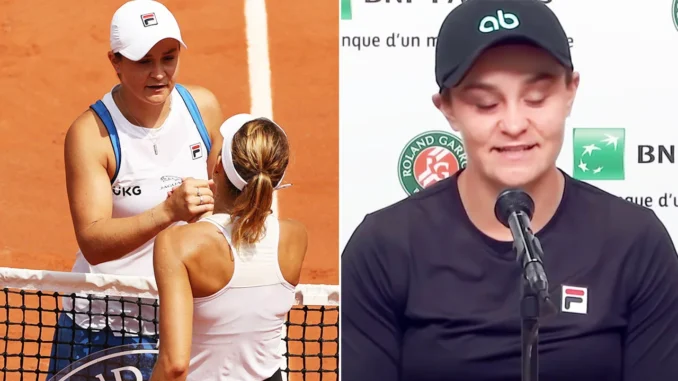
Ash Barty’s Dark Secret: The Shocking Truth Behind Her “Retirement” and The Emptiness Success Could Not Fill
At the pinnacle of sporting glory, the view is supposed to be infinite. The trophies gleam, the records stand testament, and the world applauds. For Ashleigh Barty, that pinnacle was reached on a balmy January evening in 2022 at the Australian Open. There, in her home country, before adoring fans, she lifted the Daphne Akhurst Memorial Cup, ending a 44-year Australian drought. She was World Number One, the reigning Wimbledon champion, and had just completed the ultimate dream. Then, barely two months later, at the age of 25, she walked away from it all.
The announcement, delivered via a gentle, smiling Instagram video with longtime friend and former doubles partner Casey Dellacqua, was met with global shock. How could someone so young, so dominant, so seemingly at peace, simply quit? The public narrative was one of contentment: a perfect storybook ending. But beneath the serene smile and the repeated emphasis on being “spent,” “complete,” and ready for a “new chapter,” lies a more complex, profoundly human truth—one that challenges our very conception of success and fulfillment. Barty’s “dark secret” isn’t one of scandal, but of a quiet, profound emptiness that not even the brightest spotlight could illuminate, and her retirement was not an ending, but the courageous beginning of a search for a self that tennis had long overshadowed.
The Weight of the Crown: A Prodigy’s Burden
To understand Barty’s journey, one must start not at the peak, but in the crucible of her youth. Identified as a phenom, she was thrust into the relentless, global grind of professional tennis as a teenager. Her first taste of fame was intense, winning Wimbledon as a junior at 15. But the professional circuit is a different beast—a lonely, pressurized existence of hotel rooms, airports, and the constant, gnawing demand to perform.
In 2014, at just 18, Barty first hit pause. Burned out and struggling with the isolating lifestyle, she stepped away from tennis entirely. This was the first, glaring clue that for Barty, the athlete’s life came at a severe psychic cost. She swapped her racket for a cricket bat, playing professionally for the Brisbane Heat in the Women’s Big Bash League. This wasn’t a hiatus of leisure; it was a desperate, necessary search for normalcy, for team camaraderie, for an identity beyond the baseline.
“I needed to find myself as a person,” she would later reflect. The cricket interlude was life-saving. It allowed her to breathe, to grow up away from the suffocating microscope. When she returned to tennis in 2016, it was on her own terms, but the fundamental tension remained: could the person Ash Barty survive and thrive within the all-consuming institution of Ash Barty, the tennis star?
The Paradox of Peak Performance
Her comeback was spectacular. With a refined game built on breathtaking variety—a wicked slice, potent serve, and intelligent point construction—she rose meteorically. The French Open title in 2019. The Wimbledon crown in 2021. The Australian Open triumph in 2022. The number one ranking held for 121 consecutive weeks. From the outside, this was the ultimate success story. Yet, insiders noted a subtle but consistent refrain in Barty’s commentary.
She spoke not of conquest, but of “challenge.” Not of a hunger for more titles, but of a desire to “enjoy the journey.” She famously celebrated victories not with wild parties, but by returning to her family farm, mowing the lawns, and being with her loved ones. These were not just the habits of a grounded personality; they were lifelines. Each return to normalcy was a reset, a momentary shedding of the “Champion” persona to reconnect with the simple, fundamental things that made her feel real: family, her Indigenous heritage (as a proud Ngaragu woman), her country, and the land.
The “emptiness” was not a dramatic, depressive void. It was something more subtle and insidious: the existential disconnect that can occur when your public, performing self becomes so large it threatens to consume your private, core self. Every tournament win, while joyful, also added another layer of expectation, another brick in the wall of her sporting identity. The higher she climbed, the narrower that identity became in the world’s eyes. She was Ash Barty, Tennis Champion. But who was Ash?
The Shocking Truth: Fulfillment vs. Achievement
This is the shocking truth her retirement reveals: achievement and fulfillment are not the same thing. Our modern mythology, especially in sports, conflates them entirely. We believe the trophy will fill the cup, the podium will provide the purpose. For many, it does. For others, like Barty, the higher they climb, the clearer it becomes that they are on the wrong mountain.
The relentless pursuit of sporting greatness demands a singularity of focus that can be antithetical to holistic human development. Relationships are maintained through phone screens. Personal milestones are deferred. The exploration of other passions, intellectual pursuits, or simple idle reflection is often seen as a distraction from the ultimate goal. Barty, a naturally curious and multi-faceted person, found this constriction stifling. The tennis tour, for all its glamour, is a gilded cage of routine: practice, play, media, travel, repeat. The emptiness she felt was likely the quiet yearning of a full human being to live a full human life—one with room for spontaneity, growth, and roles other than “athlete.”
Her retirement video was masterful in its authenticity. “I know how much work it takes to bring the best out of yourself,” she said. “I don’t have that in me anymore.” The key phrase: “I don’t have that in me.” The well was dry not because she had won everything, but because the cost of drawing from it—the total sacrifice of self to the sport—was no longer one she was willing to pay. The success had been achieved, but it couldn’t fill the spaces in her life that tennis had forced into shadow.
The Courage to Walk Into the Unknown
What makes Barty’s decision so radical and instructive is its proactive courage. Most athletes retire when their bodies break down or their results decline, forced out by circumstance. They are ejected from the identity they have known for decades, often leading to a painful period of loss and confusion. Barty flipped the script. She left at the very top, in full control. She wasn’t running from failure; she was walking toward possibility.
This is where the “dark secret” transforms into a powerful lesson. Barty’s story exposes the silent struggle many elite athletes face but dare not voice for fear of seeming ungrateful or weak. It questions a system that venerates the product (the champion) while often ignoring the person inside. Her retirement is an act of profound self-preservation and self-definition.
Since stepping away, the glimpses we have seen are telling. She has married her longtime partner, Garry Kissick. She released a series of children’s books, nurturing her creative side. She plays golf, enjoys grassroots sports, and immerses herself in family life. She is, by all accounts, building a life of diversified meaning. The smile, once the polite mask of a champion in press conferences, now seems to reach her eyes in a different way—unburdened, belonging entirely to her.
A Legacy Beyond the Baseline
Ash Barty’s legacy, therefore, is dual-layered. The first is etched in silverware: a Grand Slam champion in three distinct surfaces, a dominant World No. 1, an inspiration to a nation and to young athletes, particularly Indigenous children, showing them they belong on any stage they choose.
But her second, perhaps more enduring legacy, is a philosophical one. In a world obsessed with hustle culture, relentless optimization, and the never-ending climb, Barty offers a counter-narrative. She reminds us that it is okay to decide you are “complete.” It is brave to prioritize peace over prestige, self-knowledge over external validation, and a rich life over a rich career. Her “emptiness” was not a flaw, but a compass—it pointed toward what was missing, and she had the courage to follow it.
The shocking truth behind Ash Barty’s retirement is not one of darkness, but of luminous clarity. It reveals that the greatest victory is not always a title, but the sovereignty over one’s own life. She didn’t lose her passion for tennis; she simply outgrew the confines of the life it demanded. In walking away from the sport that made her a star, Ash Barty finally gave herself the space to truly rise—not as a champion, but as a whole, fulfilled, and inspiringly human self. Her story is a powerful testament that sometimes, the most radical act of success is knowing when you are finally, wonderfully, enough.
Leave a Reply