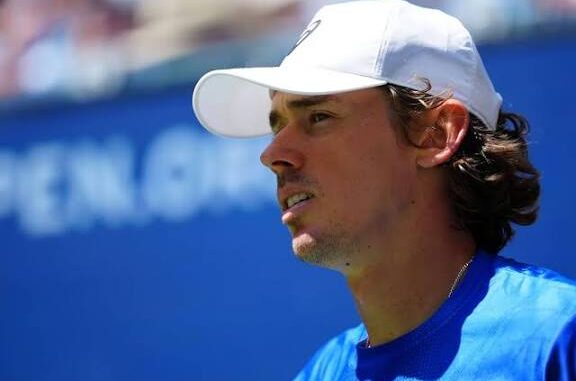
Alex de Minaur’s unexpected surge to the semifinals of the Nitto ATP Finals in Turin last week turned out to be one of the more intriguing storylines of the season’s closing event. Going into the tournament, few analysts—or even optimistic supporters—believed the Australian had a realistic chance of advancing deep into the competition. The general sentiment around him was cautious at best, as he entered the Finals without the aura of a favorite and with very little pressure to carry. Yet, despite this modest expectation, de Minaur delivered one of the most peculiar and noteworthy runs in recent ATP Finals history.
By securing a place in the semifinals, de Minaur became only the third player ever to reach that stage after winning just a single match during the round-robin phase. Before him, the rare feat had been accomplished only by David Nalbandian in 2006 and Kei Nishikori in 2016. His path through the group stage was anything but straightforward: he began the event with consecutive losses, falling first to world number one Carlos Alcaraz and then to Lorenzo Musetti. Both defeats appeared to confirm pre-tournament doubts about his chances, leaving him on the brink of elimination.
However, the narrative shifted dramatically in his final group match. Facing American star Taylor Fritz—one of the players widely tipped to dominate the tournament and a finalist in the 2024 edition—de Minaur turned the tables. Fritz had been showcasing exceptional form throughout the week and entered the matchup as the clear favorite, both statistically and in the eyes of commentators. Yet on the day of their encounter, it was de Minaur who seized control. Taking advantage of an uncharacteristically off-performance from Fritz, the Australian remained disciplined, sharp, and mentally resilient, securing a straight-sets victory that no one had anticipated. That win propelled him into the semifinals and marked one of the tournament’s most surprising developments.
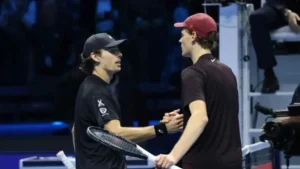
Once there, de Minaur faced the daunting challenge of trying to stop defending champion Jannik Sinner. Despite the Australian delivering what many consider one of his most complete and determined performances, the semifinal ultimately followed a familiar pattern. Sinner clinched the match, handing de Minaur his thirteenth defeat in thirteen meetings—a statistic that highlights both the Italian’s dominance and the unfortunate one-sidedness of their rivalry. Still, the match showcased de Minaur’s consistency, grit, and refusal to back down even against opponents who have historically had his number.
Among those who publicly admired de Minaur’s week was renowned coach Patrick Mouratoglou, who expressed his respect through an extensive Instagram post. Mouratoglou highlighted the Australian’s mental strength and unwavering determination, qualities he believes define de Minaur’s rise and resilience. “He said, ‘My goal is to achieve that, and I’m going to do it.’ He is the perfect example of how a player should respond after a tough defeat—how to feel the pain, accept it, understand what went wrong, and then completely reset before the next challenge,” Mouratoglou wrote, emphasizing the psychological maturity that sets de Minaur apart.
The coach continued his praise by describing the emotional transformation de Minaur underwent during the tournament. “From devastated to delivering a top-level performance, Alex de Minaur is a fighter. He reached a point of peace with himself. He accepted everything he was feeling, which is a remarkable step for any athlete serious about growth. What matters most is to look ahead, extract the lessons from each loss, and then focus only on the future. And that is exactly what he did.”
Mouratoglou’s comments underline a broader recognition within the tennis world: while de Minaur may not have the raw firepower of some of his peers, his discipline, steady mindset, and relentless work ethic continue to push him into conversations once dominated by players with bigger games but less consistency. His Turin campaign—improbable as it initially appeared—stands as another chapter in his evolution, proving that resilience and self-belief can reshape expectations in the most prestigious arenas.
Leave a Reply