Novak Djokovic’s recent visit to the Qatar Grand Prix became far more than a celebrity appearance at a Formula 1 event. While the roar of engines, pit-lane energy and driver meet-and-greets provided the spectacle expected from a global star, Djokovic’s presence carried a deeper purpose. Now 38, the tennis icon is entering a crucial period of his career—one centered on reconstructing a body that has endured one of his most turbulent and physically demanding seasons. Moving between team garages, presenting trophies after the Sprint race, and engaging with drivers and engineers, Djokovic revealed a mindset laser-focused on renewal as he prepares for what will be his 23rd season on the ATP Tour.
The 24-time Grand Slam champion is entering this off-season with a clear mission: recovery, rebuilding and re-arming himself for another wave of battles against Jannik Sinner and Carlos Alcaraz, the two players who have recently tested him in ways few others have. Djokovic wants his next showdowns with the sport’s rising powerhouses to occur under conditions where he feels physically optimal—something he rarely experienced throughout 2025. Although he still managed to reach four Grand Slam semi-finals, matching the consistency of his prime, those deep runs came with setbacks. Three of his losses across the season came at the hands of Sinner and Alcaraz, whose explosiveness and endurance often left Djokovic fighting to keep pace.
The latter stages of the season painted an even clearer picture of the wear on his body. Shoulder problems surfaced as the year closed, forcing him to manage pain carefully and ultimately ending with a title in Athens—followed by another absence from the ATP Finals in Turin, the second consecutive year he has missed the event. For a player known for extraordinary longevity and near-indestructible conditioning, these interruptions were uncharacteristically frequent. Djokovic, who first stepped onto the ATP Tour in 2004 when both Alcaraz and Sinner were still children, found himself navigating a series of physical disruptions that repeatedly broke his rhythm.
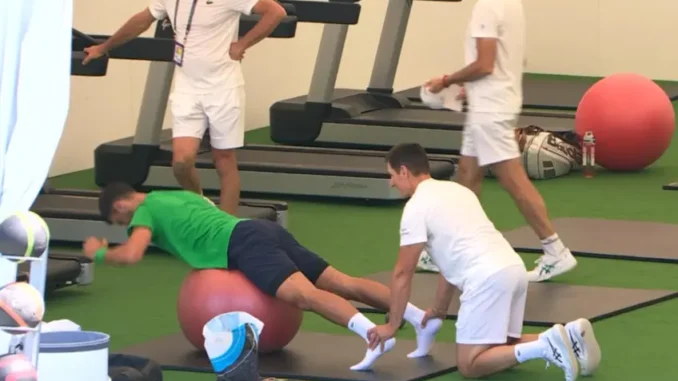
Walking through the organized frenzy of the paddock in Doha, Djokovic spoke candidly about the nature of this off-season. He described it not merely as a rest period but as a “total rebuild,” a deliberate effort to reinforce the parts of his body that have faltered too often over the past year and a half. With a rare break from tournament obligations, he has turned to meticulous fine-tuning, using the time to recalibrate his body like a high-performance engine preparing for a new season of racing. This approach aligns with his broader philosophy of holistic wellness—a theme he highlighted by unveiling his Regenesis recovery pod in Qatar, an advanced tool he believes will help him manage energy, reduce strain and extend his career deeper into his late thirties.
For Djokovic, preserving longevity isn’t just about staying on tour. It’s about sustaining a level of physical excellence that will allow him to compete for major titles and, if all goes to plan, represent his country at the 2028 Los Angeles Olympics. Each year poses new challenges, and each solution requires innovation, discipline and a willingness to adapt. The message he sent from Doha could not have been clearer: despite whispers about decline, he is not preparing to fade quietly into the background. Instead, he aims to enter 2026 healthy, recharged and fiercely competitive from the very first point of the season. If he succeeds, tennis may witness another riveting chapter in his rivalry with the sport’s newest dominant duo.
“I’m taking a short break and trying to reconstruct my machine—using racing terminology,” Djokovic explained. “I’ve been dealing with injuries more in the last 18 months than I’m used to, so this is a chance to rebuild my body and set up next season the right way. Hopefully, I can keep pace with the best guys.”
Leave a Reply