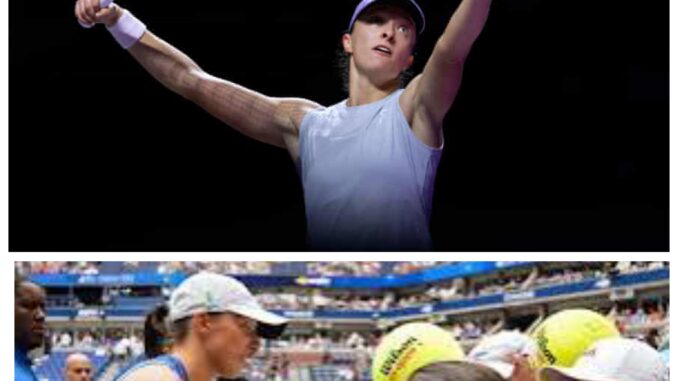
The newly crowned SW19 champion remains puzzled by post-match murmurs suggesting she ought to have allowed Amanda Anisimova at least a single game during their grand slam final. As those whispers linger, Iga Swiatek has already shifted her gaze toward the 2026 Australian Open.
Over the next several months, provided her schedule grants her a sliver of freedom, Swiatek intends to return to London and pay her respects to the All England Club—the setting of her most astonishing and, by her own admission, most unexpected victory to date. In July, the 24-year-old swept to her first Wimbledon crown, claiming her sixth major overall, dismantling a stunned Anisimova 6-0, 6-0 in a final that unfolded with an eerie inevitability.
It was the undisputed peak of a turbulent season for the Polish star, who endured uncharacteristic struggles on clay—usually her domain—yet still concluded 2025 ranked world No 2, extending her streak of top-two finishes to four consecutive years. Wimbledon adds its own curious tradition to her résumé: singles champions receive honorary membership to the All England Club, granting them access to the grounds whenever they wish. Like others before her, Swiatek is intrigued by the idea of visiting the hallowed venue in complete quiet, without crowds or competitors shadowing its pathways.
“I wonder what it feels like,” she muses. “I’ll definitely go back—I’d love to. I just don’t know exactly how it all works. I heard Roger Federer once couldn’t get in because he didn’t have the right badge, so I’ll need to be prepared.” Indeed, the Swiss legend was briefly turned away in 2022 for arriving without his membership card.
Though she has long ruled the red clay with four French Open trophies in six years, grass had always stood as a surface she eyed with hesitation, unsure whether her game would translate. But after a particularly difficult clay swing, she entered a warm-up event in Germany, sharpened her instincts, and ultimately delivered her most startling triumph.
“Any season that includes a Wimbledon title—I’m taking it without a moment’s doubt,” she says. “I’m extremely proud. I didn’t think this year would be the one. I expected it to take a couple more seasons to understand grass properly. But I felt better and better each day.”
She and her team had worked to shift long-established tactical habits, introducing patterns she hadn’t fully trusted in the past. Those adjustments, she says, clicked just in time. Yet before Wimbledon, her year had been defined mostly by frustration: one point from an Australian Open final appearance in January, but months passed before she reached another. Surprise losses on clay tested her belief, though a semifinal run in Paris steadied her confidence.
At Wimbledon, everything pivoted. From 2–2 in the opening set of her semi-final against Belinda Bencic, she strung together an astonishing 22 consecutive games, culminating in the first double-bagel women’s final since 1911. The perfection of the scoreline, however, produced questions she did not anticipate.
“I wasn’t thinking about how it looked—I was just playing. I didn’t want to give anything away for free,” she explains. “It’s a Wimbledon final. Of course I wanted to win it badly.”
But the aftermath brought its own strangeness. “There were interviews where journalists kept asking whether I should have let Amanda win one game. It was… unusual.”
To Swiatek, the match illustrated tennis’s psychological volatility. “People talked about Amanda being stressed, but I was stressed, too. A Wimbledon final on Centre Court—it’s surreal.”
Speaking from Zurich after visiting her clothing sponsor, On, Swiatek reflects on a season in which she played 80 matches—the highest tally on the WTA Tour. A brief Mauritius vacation awaits before preseason begins in December, and she hopes to scale back her tournament load in 2026.
She also eyes the one major missing from her collection: the Australian Open. Achieving the career grand slam would place her among only 10 women in history. With a tightening top 10 and Aryna Sabalenka still ahead of her, she and coach Wim Fissette are refining a precise plan.
“There’s so much I learned this year,” she says. “My goal is to blend the new things with what already works—to feel confident in my variety, and to know exactly which skills to use and when.”
Leave a Reply