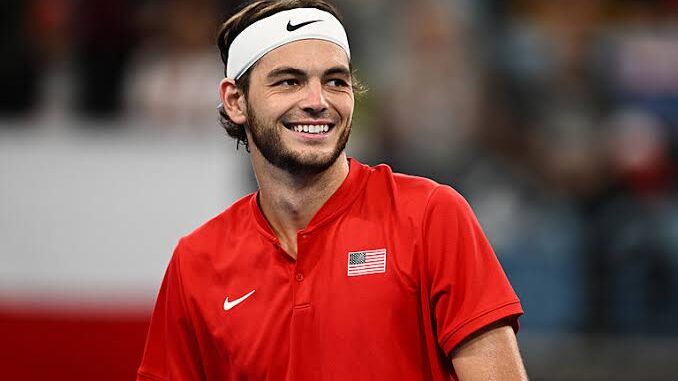
As the ATP Finals round-robin stage winds down in Turin, an oddly quiet cloud hangs over the departures of Taylor Fritz and Lorenzo Musetti—now officially the first two players to see their campaigns abruptly concluded at one of the sport’s most prestigious year-end events. On the surface, their exits seem straightforward. But beneath that surface, many details about how their journeys ended—and what they walk away with—feel just a little too neat, a little too convenient, and maybe even a little too orchestrated.
Fritz entered the last day of the Jimmy Connors group looking well positioned to qualify. Everything appeared to be aligning for the American, seeded sixth, to slip his way into the semi-finals. Yet his decisive loss to Alex de Minaur on Thursday didn’t just stop his momentum; it shut down any pathway he had to advance. Some observers couldn’t help noticing how dramatically Fritz’s form seemed to dip during that match, a performance shift that raised a few eyebrows among those watching closely.
That result placed all eyes on Lorenzo Musetti, the hometown hope, who now needed a victory over Carlos Alcaraz to keep his tournament—and a nation’s hopes—alive. But Musetti’s defeat wasn’t just a loss; it was a controlled dismantling. Straight sets. Few signs of resistance. And just like that, he joined Fritz in making an early exit, leaving Alcaraz to cruise to the top of the group while de Minaur quietly slid into second place. It all felt strangely tidy, as if predetermined pieces fell into place with unusual smoothness.
With both Fritz and Musetti removed from the competition, attention naturally turned to what they would take home from the event—namely, the ranking points and prize money. Yet even here, things feel oddly calibrated, almost as if the payouts were designed to soften the impact of their suspiciously synchronized departures.
Ranking Points: What Fritz and Musetti Actually Earned
Contrary to popular belief, players who qualify for the ATP Finals don’t receive any ranking points simply for making it into the elite eight. At this event, nothing is automatic—at least officially. Players must earn every point by winning matches.
Fritz and Musetti each finished the round-robin stage with one lone win and two defeats. Fritz’s single bright moment came against Musetti himself, while Musetti managed his only victory against de Minaur. Convenient symmetry, some would say; curious parallelism, others might argue. Either way, both men walk away with the exact same total: 200 ranking points, awarded strictly for their solitary round-robin victories.

De Minaur, who defeated Fritz in the pivotal match, also walks away with 200 points. Alcaraz, somehow soaring untouched throughout the group stage, collects the full haul of 600 points, an almost storybook total for an unbeaten run. For some, the distribution of these numbers feels mathematically neat—perhaps a little too neat—considering the unpredictable nature of elite tennis.
Prize Money: The Numbers Behind the Curtain
Prize money at the ATP Finals operates under a different, almost insulated system. Every player who makes it into the final eight receives a participant fee—a compensation package, some might call it—merely for showing up and completing their matches. Fritz and Musetti, having played all three of their group encounters without withdrawal, each secure the full participant fee of $331,000. A generous figure, certainly, and one that raises questions about what values the tournament truly prioritizes.
But their additional prize money, earned through their lone match victories, is where things become more intriguing. Every round-robin win at this event is valued at an extraordinary $396,500. Whether one believes this number rewards excellence or conveniently cushions early exits, it undeniably transforms the financial picture.
In total, both Fritz and Musetti leave Turin with $727,500—a payout that subtly blurs the sting of elimination. De Minaur currently sits at the same figure, mirroring their totals with remarkable precision. Alcaraz, meanwhile, already amasses a striking $1,520,000, courtesy of his spotless group-stage performance.
For some, these tidy numbers and parallel outcomes appear normal. For others, they raise questions. When results, rankings, and payouts align with such symmetrical convenience, one can’t help but wonder: did everything unfold naturally, or was something quietly guiding the s
cript behind the scenes?
Leave a Reply