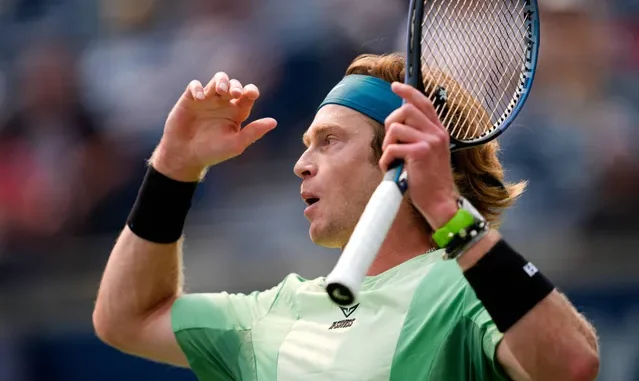
A frustrating and ultimately underwhelming 2025 season has resulted in Andrey Rublev failing to close out the year inside the world’s top ten—a position he had consistently secured since 2019. This outcome became inevitable following his narrow defeat to American rising star Ben Shelton in the round of 16 at the Paris Masters, where Rublev fell 7–6(6), 6–3. Their encounter opened with a tightly contested first set in which neither player managed a service break, but Shelton edged ahead by playing the more composed points in the tiebreak. Once the American seized the set, he carried that momentum into the second, breaking Rublev twice and ultimately sealing a result that further complicated the Russian’s hopes of repairing his ranking slide.
This loss proved significant in the ATP live rankings race. Rublev now finds himself placed 16th, trailing Casper Ruud—who currently holds the last top-ten spot—by nearly 800 points. The gap may not seem insurmountable for a player of Rublev’s caliber, yet the limited number of tournaments remaining in the season, combined with his own dip in form, has made the chase virtually impossible. For a competitor who has anchored himself among the tour’s most stable performers for half a decade, slipping this far outside the elite group marks a notable shift.
From 2020 through 2024, Rublev displayed remarkable consistency: he finished the season either in fifth place (as he did in 2021 and 2023) or in eighth (2020, 2022, and 2024). Those results reflected not only his power-based baseline game but also his disciplined scheduling and his ability to accumulate deep-run points across numerous tournaments. The 2025 season, however, has broken that pattern. His long-standing reliability has waned as his results have leveled off, and a slow, steady decline in performance—rather than one dramatic drop—has pushed him down the rankings.

Examining his year more closely, it becomes clear why Rublev’s ranking has taken such a notable hit. For the first time since 2019, he failed to reach a Grand Slam quarter-final, a category of results that normally provide him with crucial ranking support. Additionally, he has not advanced to a Masters 1000 semifinal since 2020, an absence that has significantly limited his ability to bank large point totals. These setbacks highlight how even small disruptions in form can accumulate over the course of a season, especially in an era where the competition on the ATP Tour has grown increasingly deep and unpredictable. Younger players, equipped with explosive power and unencumbered by expectation, have begun to challenge seasoned contenders like Rublev more frequently.
Despite the disappointments, the Russian’s 2025 campaign has not been devoid of encouraging moments. There were flashes of the aggressive, heavy-hitting tennis that once made him a staple of the top ten, and he produced several strong showings in ATP 250 and 500 events. Yet those brighter stretches were overshadowed by setbacks at bigger tournaments, starting with the Australian Open. In Melbourne, Rublev’s season took an unfortunate turn as he was eliminated in straight sets by rising Brazilian prodigy João Fonseca. That defeat not only ended Rublev’s streak of consecutive quarter-final appearances at the year’s first Grand Slam but also set a discouraging tone for the months that followed.
Now, as Rublev reflects on the season, the challenge ahead is clear: if he hopes to reestablish himself among the sport’s elite, he will need to rebuild confidence, rediscover consistency, and find ways to impose his game more decisively against both the tour’s veterans and its rapidly improving newcomers.
Leave a Reply