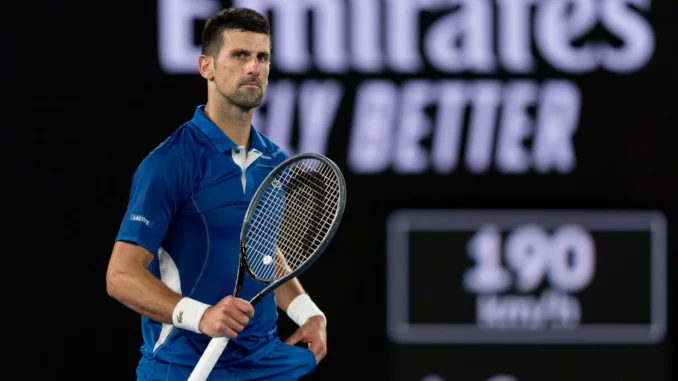
BREAKNG NEWS: Everything you need to know about Novak Djokovic special security detail at Hellenic Championship 2025 to protect him from one mishap happening again Due to…
Introduction
The world of tennis witnessed an unprecedented security development at the recently concluded Hellenic Championship 2025 in Athens, where Novak Djokovic competed under the protection of a specialized security detail. This extraordinary measure emerged as a direct response to a disturbing incident that occurred months earlier at the Italian Open, where the tennis star was accidentally struck on the head by a falling water bottle. The implementation of such enhanced protective protocols for a player of Djokovic’s stature underscores evolving concerns about athlete safety in an era of increasing fan accessibility and interaction. As Djokovic progressed through the tournament with exceptional form—advancing to the semifinals without dropping a single set—the security measures surrounding him became almost as newsworthy as his performances on court. This article examines the comprehensive security arrangements designed to safeguard one of tennis’s most celebrated figures, exploring the incident that prompted these measures, their implementation, and the broader implications for player safety in professional tennis.
The Triggering Incident: Rome Water Bottle Accident
The catalyst for Djokovic’s enhanced security detail traces back to a frightening episode at the Italian Open in May 2024, when the tennis champion found himself at the center of an alarming accident that could have ended in tragedy. Following his second-round victory against French opponent Corentin Moutet, Djokovic was engaging in what he has always done throughout his career—connecting with fans by signing autographs. Without warning, a metal water bottle fell from a fan’s backpack and struck Djokovic directly on the head. The impact was immediate and severe, with video footage showing the Serbian player collapsing to the ground while clutching his head in obvious agony .
In the aftermath of the impact, Djokovic required immediate medical attention. Tournament organizers and the Italian Tennis Federation confirmed that he had developed a noticeable bump on his head with some bleeding, though fortunately, the injury did not require stitches. The incident prompted tournament officials to release a statement clarifying that the bottle drop was entirely accidental, with a fan merely leaning over a rail while attempting to get an autograph when the bottle slipped from his backpack. Djokovic himself later took to social media to reassure concerned fans, stating, “Thank you for the messages of concern. This was an accident and I am fine resting at the hotel with an ice pack” .
Despite this public reassurance, the consequences of the incident extended beyond the immediate physical discomfort. In his following match against Chile’s Alejandro Tabilo, Djokovic appeared uncharacteristically off-form, suffering a surprising straight-sets defeat (6-2, 6-3). When asked about the injury during the post-match press conference, Djokovic revealed, “Today under high stress, it was quite bad – not in terms of pain, but in terms of this balance. Just no coordination. A completely different player from what it was two nights ago” . This admission confirmed that the incident had lingering effects that potentially impacted his competitive performance.
Psychological Impact and Historical Context
Beyond the immediate physical effects, the water bottle incident appeared to leave invisible scars on the tennis champion. According to former Italian ATP player Guido Monaco, who analyzed the episode in detail, “This incident caused a lot of blood to flow but he was very scared, regardless of whether it was accidental, he was really very scared. And even though he joked with the helmet the next day, it left mental scars” . This psychological dimension proved significant, demonstrating that even accidental incidents can have lasting emotional impacts on athletes who necessarily perform in highly accessible public spaces.
The conversation around player security inevitably draws comparisons to one of the most darkest chapters in tennis history: the 1993 knife attack on Monica Seles in Hamburg. Then-world number one Seles was stabbed between the shoulder blades by a deranged fan during a changeover, an assault that not only ended her immediate dominance in the sport but also highlighted critical vulnerabilities in player protection protocols. As Monaco starkly noted, “Let’s not forget that before the knife attack on Monica Seles, there was no security in tennis” . While tennis security has evolved substantially since that tragic incident, the Djokovic water bottle accident serves as a sobering reminder that vulnerabilities persist, albeit in different forms.
Interestingly, this wasn’t the only security-related incident involving Djokovic in recent times. During Wimbledon 2024, Djokovic was visibly disturbed by a spectator during his match against British wildcard Jacob Fearnley, explicitly telling security to “get him” while pointing toward someone in the crowd. According to reports, Djokovic identified the individual, stating, “It’s him. That guy. Get him. That guy there, the grey tracksuit just going down the stairs now” . While the nature of the disturbance wasn’t fully detailed, the episode highlighted Djokovic’s heightened awareness of potential security threats and his willingness to directly intervene when feeling unsettled by crowd elements.
Hellenic Championship 2025: Enhanced Security Protocols
Months after the Rome incident, as Djokovic competed at the inaugural Hellenic Championship 2025 in Athens, tournament organizers implemented exceptional security measures specifically designed to prevent any recurrence. The most visible manifestation of this enhanced protection came following Djokovic’s quarterfinal victory over Nuno Borges, when a dedicated security personnel was positioned immediately beside him during his traditional fan interaction period. In a telling detail reported by observers, the security guard went so far as to protectively hold his hand over Djokovic’s head while the player signed autographs for enthusiastic fans .
This physical protection strategy represented a practical solution to the specific vulnerability exposed in Rome—the potential for falling objects from above. While some might view the image of a guard shielding a player’s head as unusual, it addressed the precise mechanism of the earlier accident with straightforward effectiveness. The security team maintained a constant, vigilant presence during these fan interaction sessions, positioned to monitor crowd movements and respond instantly to any potential hazards.
The psychological value of these measures likely extended beyond their physical protection. With the “mental scars” referenced by Monaco still presumably present, the security detail would have provided Djokovic with greater peace of mind as he fulfilled his fan engagement responsibilities. This sense of security potentially contributed to his strong performance throughout the tournament, allowing him to focus exclusively on his tennis without the distraction of safety concerns. The fact that he advanced through the tournament without dropping a set suggests a player operating with minimal distractions and maximum concentration.
Djokovic’s Performance at the Hellenic Championship
Despite the heightened security surrounding him, Djokovic’s competitive focus remained unwavering throughout the Athens tournament. His progression to the semifinals featured commanding victories over Alejandro Tabilo (7-6 [7-3], 6-1), Nuno Borges (7-6 [7-1], 6-4), and Yannick Hanfmann (6-3, 6-4) . His performance against Hanfmann in the semifinals proved particularly significant, as it marked his first victory at this stage of a tournament in several attempts, effectively ending what media outlets had dubbed his “semi-final hoodoo” .
Djokovic’s own assessment of his semifinal performance revealed a player regaining confidence and form at a crucial juncture in the season. “I think it was the best tennis I’ve played this tournament,” he stated after defeating Hanfmann. “It came at the right time. Hanfmann poses a great threat because he serves big, has a big game, so I needed to really stay focused. I was a break down in the second, but I held my composure. I’m very excited for the final” . This renewed confidence, coupled with his 101st career title pursuit, underscored how emotional and physical security can directly impact athletic performance at the highest levels.
The Hellenic Championship itself represented an important new addition to the ATP calendar, marking the return of elite professional tennis to Greece after a considerable absence. The tournament replaced the former Belgrade Open, with matches held at the historic OAKA Basketball Arena in Athens . Djokovic’s deep run in this inaugural event, particularly under specialized security protocols, added a distinctive chapter to both the tournament’s history and his own storied career.
Broader Implications for Player Security in Tennis
The implementation of specialized security for Djokovic raises important questions about the evolution of player protection across professional tennis. While the Rome incident was accidental rather than malicious, it exposed vulnerabilities that could be exploited by individuals with harmful intentions. The tennis community has historically struggled to balance the sport’s tradition of player accessibility with evolving security requirements in an increasingly unpredictable world.
Table: Comparison of Tennis Security Incidents and Responses
| Date | Event | Incident | Response |
|---|---|---|---|
| May 2024 | Italian Open | Djokovic struck by falling water bottle | Initial medical attention; later enhanced security at subsequent tournaments |
| July 2024 | Wimbledon | Djokovic reported disruptive spectator | Security spoke to spectator but allowed return to seat |
| 1993 | Hamburg | Monica Seles stabbed by fan | Implemented basic security protocols; began re-evaluation of player protection standards |
| November 2025 | Hellenic Championship | Preventive security measures | Dedigned security guard physically protecting Djokovic during fan interactions |
The economic and ethical dimensions of enhanced player security cannot be overlooked. Implementing specialized security details represents a significant financial investment for tournament organizers, potentially creating disparities in protection levels between top-ranked players and lower-ranked competitors. This raises questions about whether all players should receive comparable security measures regardless of ranking, and who should bear responsibility for funding these initiatives—tournament organizers, tennis governing bodies, or the players themselves.
Conclusion
Novak Djokovic’s specialized security detail at the Hellenic Championship 2025 represents more than just a reactive measure to a single accident—it signifies an evolving understanding of athlete safety in modern professional sports. The image of a security guard physically shielding the tennis champion’s head during routine fan interactions may appear unusual to casual observers, but it reflects a calculated response to demonstrated vulnerabilities in player protection protocols. As tennis continues to navigate the delicate balance between maintaining its traditions of accessibility and ensuring competitor safety, the measures implemented in Athens may well become standardized for high-profile players across the tour.
For Djokovic personally, these security arrangements appear to have provided the necessary stability for him to excel competitively, as evidenced by his strong performance throughout the Athenian tournament. As he advances in his pursuit of a 101st career title—potentially edging closer to Jimmy Connors’ all-time record of 109—the peace of mind afforded by proper protection measures cannot be underestimated. The Hellenic Championship of 2025 may ultimately be remembered not only for its inaugural status but for establishing new paradigms in how tennis safeguards its most valuable assets—the players who make the sport extraordinary. In an era where athlete safety concerns continue to evolve, the tennis world has sent a clear message: protecting its stars remains an absolute priority, both for their wellbeing and for the future of the sport itself.
Leave a Reply