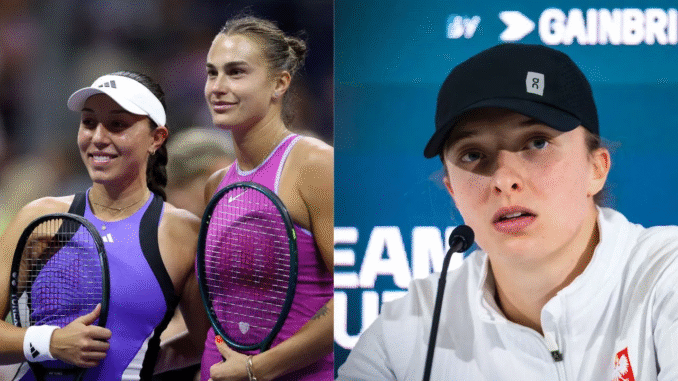
They Shut Us All Up: Iga Swiatek, Jessica Pegula & others hit back with THREATS at Slams for ‘frustrating’ stalled negotiations Amidst Controversies Due To…
In the high-stakes world of professional tennis, a quiet revolution is brewing. For years, the sport’s grandest stages—the Grand Slams—have operated with significant autonomy, making decisions that directly affect athletes with limited player input. Now, in an unprecedented show of unity, the world’s top tennis players are collectively raising their voices, frustrated by stalled negotiations over revenue sharing, player welfare, and meaningful consultation.
Leading this charge are household names like Iga Swiatek, Aryna Sabalenka, and Jessica Pegula, who are voicing concerns that extend far beyond their own paychecks. They are advocating for systemic changes that would benefit the entire tennis ecosystem, from the top-ranked stars to the journeymen players struggling to cover travel and coaching costs. This is the story of a long-overdue confrontation between the athletes who are the lifeblood of the sport and the powerful institutions that profit from their talents.
A Unified Front: The Players’ Demands
The current standoff isn’t a spontaneous outburst of frustration. It is the result of a calculated and united campaign by the top players from both the WTA and ATP tours. Earlier this year, the top 10 men and women joined forces, a rare occurrence in a sport often divided by tour and gender, to send a formal letter to the four Grand Slams—Wimbledon, the French Open, the US Open, and the Australian Open.
Their demands are clear, reasonable, and centered on three pillars:
-
Fair Revenue Sharing: Players are seeking a more equitable distribution of the massive revenues generated by the Slams. Currently, only about 13% to 15% of Grand Slam revenue is paid out as prize money. The players have proposed a staged increase towards 22%. For context, other major sports leagues like the NBA and NFL share approximately 50% of their revenues with athletes.
-
Player Welfare Programs: The Grand Slams do not contribute to tour-funded welfare programs such as pensions, healthcare, and maternity pay. In contrast, the ATP and WTA tours pay a combined $80 million each year towards these benefits. This is a critical issue for lower-ranked players who operate at a financial loss for much of the season.
-
A Seat at the Table: Players are demanding the formation of a Grand Slam Player Council to ensure they are formally consulted on matters that affect their careers, such as scheduling changes, rules, and prize money allocation. This call for dialogue is at the heart of the current frustration.
The Voices of the Movement
The unified nature of this movement gives it a credibility that previous complaints have lacked. The player representatives include a who’s who of modern tennis: Aryna Sabalenka, Jannik Sinner, Coco Gauff, Casper Ruud, Madison Keys, and Alex de Minaur. Their message is consistent and clear.
Iga Swiatek, the world number one, cut to the heart of the issue, stating, “For sure it would be great if the Grand Slams wanted to talk to us, because that’s how it’s supposed to be and I don’t really get why there’s no more open conversation.” She emphasized that the concerns go beyond finances, touching on “the pension, the health plan and just having more smooth cooperation and communication in the future.” She bluntly assessed the stalled talks as a “setback” and confirmed that “the players are not happy with it”.
Aryna Sabalenka echoed this sentiment, highlighting the urgency for resolution: “I think it’s the time right now to sit at a table and come to a conclusion that everyone will be happy with”.
Perhaps the most telling comments come from Jessica Pegula, a member of the WTA Player Council, who underscored the collective nature of the effort. “We’re just trying to be a united voice,” she said. “I think it’s the first time we’ve actually been able to come together with both tours. And so that’s a testament to just everybody being really open-minded and wanting to come together on making our sport better and better for the players.” She then pointedly noted that the Slams are “not really responding” and that “the ball is a little bit in their court right now”.
The Grand Slams’ Response: Delays and Obstacles
The players’ initial overtures were met with some engagement. A first meeting was held in Paris during Roland Garros in May, with further discussions taking place at Wimbledon a few weeks later, facilitated by former WTA chief Larry Scott, who is acting as an advisor for the players.
However, communication stalled during the summer. The Grand Slams informed the players that they would have to postpone further discussions until other, seemingly more pressing, matters are resolved. The reasons cited by the Slams include:
-
The antitrust lawsuit launched against them by the Professional Tennis Players Association (PTPA).
-
Potential plans for a massive restructuring of the sport in favor of a “premium tour”.
The players, in a second letter sent on July 30, expressed that they did not believe these other plans should delay action on their proposals. This view was publicly supported by Jannik Sinner, who stated, “Calendar and scheduling are important topics, but there is nothing stopping the slams from addressing player welfare benefits like pensions and healthcare right now”.
The table below summarizes the key events in this ongoing negotiation:
| Timeline | Event | Outcome |
|---|---|---|
| March 2025 | Top 10 ATP & WTA players send a joint letter to Grand Slams. | Demands made on revenue, welfare, and consultation. |
| May 2025 | First meeting between player reps and Slams at Roland Garros. | Initial dialogue established. |
| July 2025 | Follow-up meetings at Wimbledon. | Further discussions, but no concrete action. |
| Summer 2025 | Communication stalls. | Slams cite PTPA lawsuit and “Premium Tour” plans as reasons for delay. |
| July 30, 2025 | Players send a second letter urging action. | Demands reiterated; frustration grows. |
| November 2025 | Players speak out from the WTA Finals in Riyadh. | Swiatek, Sabalenka, and Pegula publicly call out the Slams’ silence. |
A Broader Pattern of Disregard
The current negotiation stalemate is not an isolated incident. It fits into a broader pattern where player concerns, particularly those of women, have been minimized or ignored by the sport’s power brokers.
The Roland Garros Night Session Controversy
A clear example of this dynamic is the ongoing scheduling controversy at the French Open. Since introducing the night session format in 2021, Roland Garros has scheduled only four women’s matches in the prime-time slot out of 52 total sessions—a mere 7.7%. In 2025, the tournament scheduled zero women’s matches for the night session.
When questioned about this disparity, tournament director Amélie Mauresmo claimed the scheduling was based on match length, as men’s best-of-five-set matches guarantee a longer duration. This explanation rings hollow for players and fans alike. Ons Jabeur, a former WTA World No. 2, criticized the logic, stating, “It’s a bit ironic… They don’t show women’s sport, they don’t show women’s tennis, and then they ask the question, ‘yeah, but mostly they watch men’. Of course, they watch men more because you show men more”.
Aryna Sabalenka pointed out the practical impact, noting that great women’s battles deserve a bigger stage with better timing to attract more viewers. The message is clear: by consistently relegating women’s matches to less desirable time slots, the tournaments themselves are devaluing the product and then using a lack of visibility as a justification for continued neglect.
A System Under Scrutiny
The players’ grievances are part of a larger critique of tennis governance. The Professional Tennis Players Association (PTPA), co-founded by Novak Djokovic, has filed an antitrust lawsuit accusing the ATP, WTA, and ITF of operating like a “cartel” that suppresses player wages and opportunities. While this legal action is separate from the current player-Slam negotiations, it stems from the same root: a belief that the sport’s structure is fundamentally unbalanced and fails to treat players as true partners.
The Grand Slams, as the most lucrative and influential events in tennis, sit at the apex of this system. Their reluctance to engage in good-faith negotiations on revenue and welfare only reinforces the players’ perception that the status quo is designed to keep them in their place.
The Road Ahead: What’s Next for the Player Movement?
As the world’s best players continue to compete at the highest level, their fight for a fairer sport continues off the court. The public statements from Swiatek, Sabalenka, and Pegula at the WTA Finals are a clear escalation, moving the conversation from private letters to the court of public opinion.
The players have shown they are organized, united across gender and tour lines, and are not backing down. They have made it clear that their demands are not just about enriching the top stars but are about creating a more sustainable and equitable sport for everyone who dedicates their life to it.
The ball, as Jessica Pegula noted, is now in the Grand Slams’ court. Will they finally agree to sit down and negotiate in good faith, or will they continue to hide behind legal delays and bureaucratic excuses? The future of professional tennis depends on their choice. One thing is certain: the players have found their voice, and they are no longer willing to be silenced.
Leave a Reply