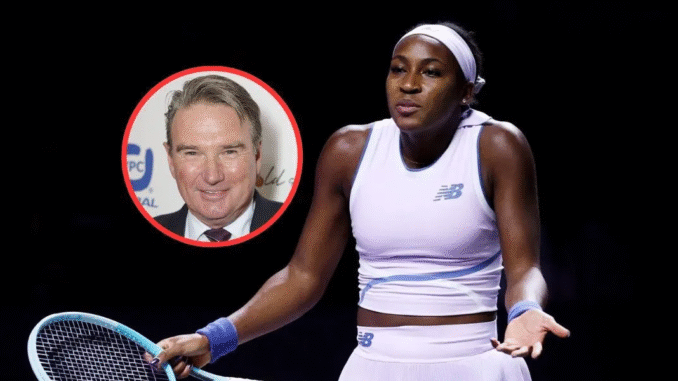
After battling with form at the WTA Finals, Coco Gauff receives surprising advise from Jimmy Connors, which makes her hesitant to make a decision based on controversies due to…
Introduction
In the high-stakes world of professional tennis, even the most gifted athletes encounter moments of crisis that define their careers. Coco Gauff, the 21-year-old American phenom, recently faced such a moment following her premature exit from the 2025 WTA Finals in Riyadh. After struggling with form and consistency throughout the tournament, Gauff found herself at a professional crossroads, uncertain about which path would lead her back to championship form. Into this uncertainty stepped an unlikely voice—tennis legend Jimmy Connors—whose surprising advice has sparked both admiration and controversy, leaving the young star hesitant about her next move even as she advocates for fairness in the sport.
This clash of generations, between a rebellious champion from tennis’s wild past and a thoughtful champion navigating the modern game, reveals the complex pressures facing today’s athletes. As Gauff balances technical adjustments, mental fortitude, and the constant glare of public scrutiny, her journey exemplifies the challenges confronting a new generation of tennis professionals.
Gauff’s Form Struggle: A Champion in Transition
Coco Gauff’s title defense at the 2025 WTA Finals was unexpectedly brief. The World No. 3 suffered two losses in three group stage matches—defeats against Jessica Pegula and Aryna Sabalenka that exposed persistent flaws in her game . Though she managed a convincing victory over Jasmine Paolini, this lone win couldn’t mask the underlying issues that have plagued her season. The most glaring problem? A serve that has transformed from potential weapon into consistent liability.
The statistics are sobering. In her match against Pegula alone, Gauff committed 17 double faults—the equivalent of handing her opponent more than four full games worth of points . This troubling pattern isn’t isolated to a single match; across her 61 matches in 2025, Gauff has accumulated a staggering 405 double faults, leading the WTA tour in this undesirable category . By comparison, World No. 2 Iga Swiatek has committed 226 double faults, while World No. 1 Aryna Sabalenka sits 42nd with just 154 . This dramatic discrepancy highlights a technical flaw that has become psychological baggage.
What makes Gauff’s serving struggles particularly fascinating is her continued success despite them. Earlier in 2025, she captured her second Grand Slam title at the French Open, demonstrating the mental resilience and competitive fire that have become her trademarks . This contrast between spectacular achievement and persistent technical flaws encapsulates Gauff’s current transitional phase—she wins through athleticism and willpower when her fundamentals betray her.
Connors’ Unexpected Advice: Wisdom from a Rebel
When Jimmy Connors speaks about tennis, the listening is rarely casual. The former World No. 1 and eight-time Grand Slam champion was known throughout his career for his rebellious demeanor and relentless competitive fire . Yet on a recent episode of his “Advantage Connors” podcast, the 73-year-old legend offered surprisingly measured counsel to the struggling young champion.
The Mental Framework: Stop Beating Yourself
Connors’ primary advice centered on mentality rather than mechanics. He emphasized the importance of making opponents earn their victories rather than gifting them opportunities through unforced errors.
“Make your opponent beat you. Don’t beat yourself,” Connors stated succinctly, articulating a competitive philosophy that defined his own legendary career .
This fundamental principle gets to the heart of Gauff’s recent struggles. With the serve creating such dramatic volatility in her matches, she often finds herself fighting not only her opponent but her own game. Connors’ advice reframes competitive tennis as a test of consistency and patience—qualities that can stabilize a player through technical transitions.
The Technical Prescription: Timing Your Changes
Beyond mentality, Connors addressed the practicalities of technical improvement, specifically questioning Gauff’s timing in overhauling her serve. Just days before the US Open, Gauff had made the bold decision to hire biomechanics specialist Gavin MacMillan—the same expert who helped Aryna Sabalenka overcome her serving yips . Connors suggested that such fundamental changes require the sanctuary of the offseason, not the pressure-cooker environment of major tournaments.
“She’s got six or seven weeks to regroup and not continue to try to improve and do things on the fly,” Connors observed. “That’s hard to do, to go in and be put under the pressure of winning matches, tournaments, beating the best players when you’re trying to make changes. Changes are to be made in the off season, not when you’re trying to win a title.“
This practical wisdom stems from Connors’ understanding of the psychological toll technical adjustments take during competition. When muscle memory falters mid-match, and thousands of spectators (plus millions more watching globally) await the result, players often revert to old patterns under pressure, defeating the purpose of the changes.
Connors’ Complex Legacy: From Rebel to Elder Statesman
The irony of Jimmy Connors—once tennis’s ultimate rebel—dispensing measured advice to a younger generation shouldn’t be lost on observers of the sport. Throughout his playing career, Connors cultivated an image as an “outsider, rebel, fighter, purist” who “didn’t give a damn about what you thought and had no problem letting you know that with creative language and choice fingers” .
His memoir, “The Outsider,” reveals a competitor full of contradictions—a man who professed to love the game above all else but frequently made decisions based on financial considerations, and who claimed not to care about others’ opinions while sometimes stirring up contrived controversies to entertain crowds . Yet this complex history lends credibility to his advice; Connors understands the psychological games within the game because he played them masterfully.
There’s historical symmetry in Connors advising Gauff during a period of professional uncertainty. Throughout his career, Connors himself occasionally displayed surprising sportsmanship, most notably during the 1975 Australian Open final when he intentionally double-faulted to protest three consecutive controversial calls that had gone in his favor . Though he lost the game, set, and ultimately the match, the gesture demonstrated his understanding of tennis as not just a competition but a spectacle with unwritten rules of fairness .
The Nature of Controversy: Why Gauff Hesitates
Connors’ advice, while prudent, arrives when Gauff is already navigating multiple controversies that understandably make her hesitant about her next moves. Unlike previous generations of athletes who could make technical adjustments away from the spotlight, today’s stars undergo every transformation under microscopic public scrutiny.
The Serve Transformation Controversy
Gauff’s decision to overhaul her serve mid-season sparked immediate debate. Her hiring of MacMillan just days before the US Open represented what she called “a real solution” to a problem that had plagued her for years . As a self-described “very logic-based person,” Gauff found MacMillan’s biomechanical approach appealing after trying numerous other suggestions that failed to help .
Yet the timing created immense pressure. “I felt the pressure to all of a sudden have a brand-new serve within four days, which I knew it wasn’t possible, but I think a lot of people were expecting that,” Gauff acknowledged . This expectation—that technical changes should yield immediate results—ignores the reality of muscle memory and the difficulty of altering ingrained patterns under competitive pressure.
The Olympic Controversy and Advocacy
Beyond technical concerns, Gauff has found herself advocating for systemic changes to the sport itself. During her second-round loss at the Paris Olympics, a controversial umpire decision overruled a linesperson’s call, costing Gauff a critical point despite her argument that the initial call had affected her shot execution .
In an emotional exchange with officials, Gauff expressed the frustration many athletes feel when external decisions override their performance: “I feel like I’m getting chepped constantly in this game… There have been multiple times this year where that happened to me where I feel like I always have to be an advocate for myself on court.“
Her call for tennis to implement a VAR (Video Assistant Referee) system highlighted her role as not just a competitor but an advocate for fairness in her sport . This incident, combined with her serving struggles, represents the dual challenges Gauff faces: technical and systemic.
The Bigger Picture: Athlete Advocacy and Systemic Challenges
Gauff’s experiences reflect broader patterns in professional tennis, where today’s athletes are increasingly asserting control over their careers and challenging traditional structures. The emergence of the Professional Tennis Players Association (PTPA), co-founded by Novak Djokovic, represents an organized effort to secure greater player rights and revenue sharing .
Like Gauff’s individual advocacy, the PTPA’s legal challenges focus on issues like the “exhausting 11-month season,” the “lack of financial transparency,” and rules that “artificially limit players’ earning potential” . These systemic concerns form the backdrop against which individual competitors like Gauff make career decisions.
The generation gap between Connors and Gauff becomes particularly evident here. Connors recalls playing for different financial stakes and constraints, noting, “I came up in a time when winning a tournament, I made $1,200 bucks, not $5 million bucks” . Yet he also acknowledges the modern athlete’s reality, stating that “the year is long anyway, and they keep adding more” .
This tension between playing opportunities and athlete burnout affects even the sport’s biggest stars. Jannik Sinner recently faced criticism for skipping the Davis Cup despite his previous contributions to Italy’s back-to-back titles . His decision, like Gauff’s serving changes, represents an athlete prioritizing long-term career management over immediate expectations—a calculation previous generations rarely had the luxury to make.
The Path Forward: Synthesis and Resolution
As Coco Gauff processes Jimmy Connors’ advice during her six-week offseason, she faces a series of critical decisions that will shape her 2026 campaign and beyond. The solution likely lies in synthesizing the wisdom of tennis past with the realities of tennis present.
Embracing the Offseason
Connors is undoubtedly correct that technical changes—particularly to a shot as fundamental as the serve—require the relative tranquility of the offseason. Gauff has already acknowledged the progress made through her work with MacMillan, noting that “the stats in the last few tournaments have shown that it’s got better since I started” . Dedicating the offseason to ingraining these changes without competitive pressure could yield significant dividends.
Trusting Her Resilience
Throughout her young career, Gauff has consistently demonstrated the mental toughness that Connors rightly identifies as crucial. From her breakthrough Wimbledon run as a 15-year-old to navigating the pressure of home Grand Slam expectations, she has repeatedly shown capacity to thrive under circumstances that would overwhelm many older players.
Her ability to win two prestigious titles in 2025—including the French Open—despite her serving struggles testifies to this extraordinary resilience . As Connors observed, “She’s got all of that. If she gets her mind right and gets a few things straight then she will be back on top in a heartbeat.“
Balancing Advocacy and Performance
Finally, Gauff must continue balancing her role as both competitor and advocate. Her call for VAR technology in tennis and her willingness to speak openly about mental health challenges represent an evolution in what it means to be a professional athlete. Like Serena Williams and Venus Williams before her, Gauff understands that her platform extends beyond the court.
Conclusion: The Making of a Legend
Coco Gauff’s current struggles, while challenging, represent the necessary refining fire through which all great champions pass. The unexpected advice from Jimmy Connors—once tennis’s ultimate rebel turned elder statesman—provides valuable perspective as she navigates this transitional phase.
What makes Gauff’s journey particularly compelling is her awareness of both the technical and systemic challenges facing modern athletes. Her willingness to overhaul her serve mid-season demonstrates courage; her advocacy for fair treatment shows maturity beyond her years. As she processes Connors’ wisdom about making opponents beat her rather than beating herself, she embodies the evolution of tennis itself—honoring its past while forging a more equitable future.
The coming offseason offers Gauff something precious: time away from the spotlight to ingrain technical changes, mental refreshment, and perspective. When she returns for the 2026 season, the lessons from this difficult period—combined with her innate talent and fighting spirit—may well propel her to the consistent dominance she seeks. In the meantime, her journey reminds us that even phenoms face moments of uncertainty, and that sometimes, the most unexpected advice can light the path forward.
Follow the continued journey of Coco Gauff as she prepares for the 2026 season, where she aims to return with a refined game and the wisdom gained from navigating professional tennis’s toughest challenges.
Leave a Reply