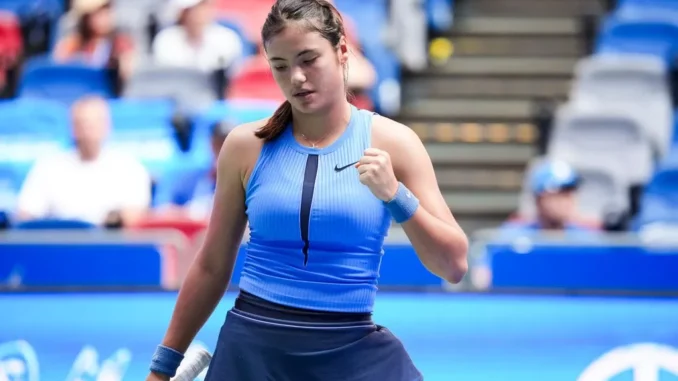
Tennis fans and media do love a narrative: the fallen champion, the comeback, the mystery behind the scenes. Emma Raducanu, once the wunderkind of British tennis after her 2021 US Open fairy tale, is back in the spotlight — but now for reasons less triumphant, and more contentious. The claim doing the rounds is that she has been granted “special treatment” to protect her WTA ranking despite a weak season and chronic injuries. That allegation is explosive: if true, it compromises the integrity of ranking systems; if false, it betrays a cynical motive to undercut a popular story. As with many sports controversies, the truth lies somewhere in partials — and what is (or is not) said in public.
Let’s unravel this.
Raducanu’s 2025 Season: Injuries, Early Exits, and Context
First, we need to establish the baseline: Raducanu’s performance and health in 2025.
-
Raducanu recently ended her season early citing health troubles and physical struggles. ESPN.com
-
At the Wuhan Open, she was forced to retire mid-match against Ann Li due to dizziness, after having medical tests (blood pressure, etc.). ESPN.com+1
-
In China later, at the Ningbo Open, she lost in the first round to Zhu Lin, calling trainers twice and visibly laboring through a match in which her lower back issues flared up. The Guardian+1
-
She has a history of recurring back spasms and a vulnerable back, which in past tournaments has undermined her service motion and consistency. Tennis365+1
-
Her recent match reports note she appeared lethargic, called doctors, and overall was far from her peak physical self. Sky Sports+2The Guardian+2
So on the “injury / poor performance” side, the facts are solid: she has not had a robust season, she has retired or faded in key matches, and physical limitations have been clear.
Yet against that backdrop, the chatter is that somehow — through some mechanism or insider favor — her ranking has been cushioned. (“Special treatment” is the loaded phrase.)
What “Special Treatment” Could Mean — And Whether There’s Evidence
“Special treatment” is vague. It could mean:
-
Protected ranking or exemptions — allowing a player to maintain or recover ranking points despite injury.
-
Wild cards into main draws (which indirectly help with points opportunities).
-
Soft handling or leniency in ranking rules (e.g. not penalizing her as harshly for missing tournaments).
-
Insider bias in tournament entries / seedings / draws (less likely but part of the rumor ecosystem).
Let’s see which (if any) are plausible in Raducanu’s case, given what we know.
Protected Ranking & WTA Rules
The WTA has provisions for injury protection: a player out for a long stretch can use a “protected ranking” to enter tournaments based on prior ranking. But that mechanism is transparent and regulated; it’s not something done ad hoc. There’s no credible public record (so far) that Raducanu has been granted any extraordinary ad hoc protection beyond those standard rules.
Her Wikipedia and official career summaries show how her ranking has shifted over time, reflecting injuries and withdrawal periods; they do not mention any secret boosts or overrides. Wikipedia
If “special treatment” is to be believed, then one should point to a rule either bent or ignored in her favor. I have seen no credible public source that documents such a bending for Raducanu in 2025.
Wild Cards & Draw Access
Raducanu, being a high-profile name, may receive wild cards into tournaments or draws where her raw ranking might otherwise not suffice. That is common in tennis — marquee players often get favorable entry. If she is getting more wild cards than usual relative to a low ranking, critics might interpret that as “special treatment.”
However, a wild card is not the same as guaranteed ranking protection; it just gives opportunity to compete. Whether she translates that opportunity into points is up to performance.
There is some media commentary about her being seeded in the Australian Open thanks to her ranking (around 29) despite physical woes. ESPN.com Also note that in the China swing she had wild card and entry-press lists implicating tournament organizers’ willingness to include her. The Guardian+1 But none of that strictly proves manipulation of the ranking system itself.
Lenient Penalties for Absences
If the WTA or tournaments quietly waived penalties or did not impose the same point drops for her missed tournaments — that would be a sort of “soft bias.” But I found no credible press or regulatory document claiming the WTA made such a one-off exception for her. The association tends to avoid public perception of favoritism because it opens itself to criticism.
Insider Bias in Seeding or Draws
This is a more speculative variant: that tournament draws or seedings are subtly influenced to protect or favor her. Such claims exist in tennis lore (favoring big names in draws). But again, I found no credible public reporting naming a draw that was shady, or seed adjustments strictly for her benefit.
Thus, “special treatment” in the sense of rule-breaking or favoritism is a claim with little publicly documented evidence so far. That doesn’t mean the claim is impossible, but it means skepticism is warranted.
Why the Rumor Persists: Narratives, Public Sympathy & the Vulnerable Champion
Even without solid proof, the narrative of “special treatment” is powerful. Here’s why it sticks.
Star Power & Legacy Bias
Raducanu is one of those rare cases: she burst onto the scene in dramatic fashion (US Open 2021). She carries both public sympathy (the young, troubled champion) and commercial value. Whenever she’s struggling, there is audience desire for her to bounce back. That creates a lens: fans and commentators are primed to detect signs she’s being “protected.”
When a high-profile player falters yet maintains ranking, some see it as “leapfrogging merit.” There’s always a temptation to imagine that institutions protect their stars.
The Gap Between Public Perception & Ranking Mechanics
Ranking systems in tennis are complex. They include points for performance, mandatory tournaments, protected ranking rules, wild card allowances, and more. Many fans don’t see that machinery; they see a name on a list and think “she shouldn’t be here.” That confusion fuels claims of manipulation.
When a star exits early but still hovers high in rankings, the optics look off — even if there’s a transparent explanation someplace deep in the rulebook. Those explanations rarely get publicized at a level that satisfies skeptics.
Injury, Sympathy, and Relaxed Critique
Because Raducanu has publicly struggled with injuries, critics may be reticent to press certain lines. That gives room for speculation to thrive in shadows. When she withdraws, or does poorly, it’s blamed on her body; when she maintains rank, it’s blamed on favoritism. The narrative is asymmetrical.
The “Privilege Conspiracy” Lens
In sports, there is always a tension—some athletes (or teams) are perceived as privileged. Big-name players, those from powerful federations or with media backing, are sometimes accused of bending rules. The claim about Raducanu fits into that broader schema: is tennis more favorable to “brands” than to pure performance?
The Stakes: Governance, Fairness, and Trust
This rumor matter is not just gossip. If claims of “special treatment” gained traction and had some foundation, it erodes trust in:
-
The ranking system’s legitimacy — if rules can be bent for certain players, then the fairness basis is compromised.
-
Tournament entry integrity — if entry or seeding is influenced by favoritism, it impacts competitive equity.
-
Player morale — lower-ranked players might feel disincentivized if they believe rules favor stars.
-
Public confidence in sport governance — fans need to believe that the “rules of the game” apply equally; if the elite get soft pass treatment, interest and credibility suffer.
Given those stakes, responsible journalism and transparent rule enforcement are vital.
What One Should Watch Going Forward
-
Official statements or WTA audits. If the WTA releases a breakdown of how her ranking is calculated, or addresses controversies in players’ forums, that will be revealing.
-
Comparison to other injured players. How do others with similar injury breaks fare? Do they lose more ranking weight? Are they denied entry while she is accepted?
-
Wildcard and seeding patterns. Track whether Raducanu receives more wildcards than peers, or is seeded “higher” than her performance justifies.
-
Tournament acceptance rules. See if she is being placed in draws or events without meeting typical cutoffs, or if special exceptions are being made.
-
Transparency in ranking rules. Whether the WTA publishes clear guidelines and deviations.
-
Media audits. Investigative journalism might uncover internal memos, committee decisions, or minute adjustments.
Tentative Conclusion & Balanced Take
The claim “Raducanu is being given special treatment to keep her ranking” is dramatic, and in the absence of public proof must be treated as speculative. But the conditions giving rise to that suspicion are real: she has struggled physically, underperformed, yet remains higher ranked than many think she “deserves.” That disparity invites suspicion.
Yet, the more likely explanation is a combination of:
-
Complexity of ranking rules (protected ranking, point carryovers, wild cards),
-
Tournament goodwill toward a marketable player,
-
And the lag inherent in a system where performance and consequences don’t always sync immediately.
If I were an editor on your blog, I’d headline the piece: “Emma Raducanu Fires Rumors About Rank Protection — What the Rules Show vs. What We Suspect.” Then I’d invite readers to judge for themselves via transparent data (her point totals, tournament entries, comparison to peers) rather than sensational claims.
Leave a Reply