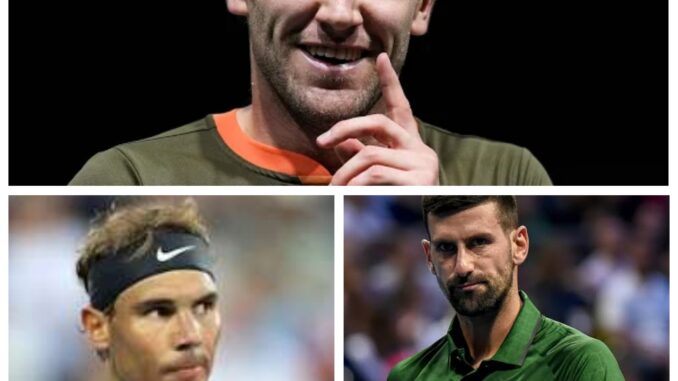
Casper Ruud has lived through two of the most daunting challenges modern tennis can offer: consecutive Roland Garros finals against Rafael Nadal in 2022 and Novak Djokovic in 2023. The Norwegian found himself under the brightest spotlight of the sport—only to be confronted by two giants who have shaped an era. Both Nadal and Djokovic overpowered him in straight sets, denying him the Coupe des Mousquetaires and reinforcing their dominance on Parisian clay. Looking back, Ruud has offered a revealing breakdown of what separated these legends from everyone else, especially when the stakes were highest.
Ruud describes the 2022 final against Nadal as something completely outside his previous experience. Nadal’s ball, loaded with signature spin and staggering weight, created an immediate physical impact that Ruud struggled to manage. From the opening rally, the Norwegian felt himself pushed into awkward court positions, forced to adjust constantly against a barrage of deep, punishing strokes. The intensity of every point drained his energy quickly. For roughly a set and a half Ruud managed to stay competitive, before Nadal surged into a higher gear and ran away with a commanding 6–3, 6–3, 6–0 victory.
Nadal was ruthless on serve, getting broken only twice, while repeatedly pouncing on Ruud’s delivery. He stole the Norwegian’s serve eight times, controlling every aspect of the match and cruising to his 14th—and ultimately final—Roland Garros title. The experience was humbling for Ruud, yet it also offered a firsthand lesson in clay-court supremacy.
 f that battle wasn’t demanding enough, Ruud returned to the final a year later, this time facing Djokovic. After enduring Nadal’s heavy topspin, Ruud now had to adjust to an entirely different style: Djokovic’s precision, flatter trajectory, and relentless accuracy. While this allowed Ruud slightly more opportunity to redirect the ball, the match only grew more complicated as it progressed. Djokovic seized a tight opening set in a tiebreak, then tightened his grip in a 7–6, 6–3, 7–5 victory that lasted over three hours.
Djokovic excelled during the match’s critical moments, fending off three of the four break points he faced and constantly applying pressure in Ruud’s service games. The Norwegian fought admirably, saving seven of ten break points, yet he could not convert enough opportunities to stretch the contest into a fourth set.
Reflecting on both finals, Ruud describes them as masterclass displays from two of the sport’s most celebrated champions—each imposing dominance in a completely different way. Nadal’s physicality, heaviness, and intensity created an immediate and enduring wave of pressure. Djokovic, though less heavy with his strokes, compensated with precision, consistency, and an impeccable ability to strike at key moments.
“I could talk about those matches for hours,” Ruud admitted. “Facing Novak and Rafa in Roland Garros finals taught me the difference between them. Novak is easier to play in the sense that he doesn’t hit with the same extreme spin or heavy ball as Rafa. Rafa wears you down from the very first point—every shot is physically demanding. Novak’s ball is flatter, so you can redirect it more easily, but he will break you down eventually too. The shock comes earlier with Rafa and never really fades. Novak is different, but both are incredible in their own way.”
Leave a Reply