
Toni Nadal has once again stepped into the center of a simmering debate—one that has hovered over professional tennis for years but rarely ignites as fiercely as it has now. With a tone that hints at warning more than nostalgia, the renowned coach has suggested that the sport may be barreling toward a physical breaking point. To him, tennis is evolving too fast, hitting too hard, and risking too much. His solution? Slow the entire game down before it reaches a place from which it cannot return.
Toni’s proposals are not small adjustments. He imagines a recalibration of the sport itself: smaller rackets that naturally reduce the explosive speed of the ball, and slower courts capable of reviving long, tactical exchanges rather than the brutal, high-velocity rallies that dominate today. His argument is simple but unsettling—modern tennis, with its escalating pace and relentless physicality, is pushing athletes to the edge. Injuries, he warns, are no longer rare accidents but predictable consequences of a sport turned into a sprinting battlefield.
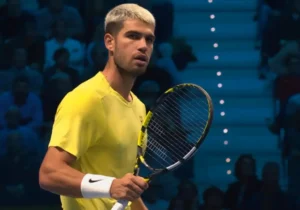
But standing firmly on the opposite side is the current world No. 1, Carlos Alcaraz, who—while respectful—cannot support Toni’s vision. For him and many of his peers, the idea of dialing back tennis is not just unnecessary; it feels like a step into a past that the sport has long outgrown. Alcaraz acknowledges the concerns, but insists that tennis cannot—must not—move backwards.
To the young champion, the evolution from wooden frames to graphite, from slow surfaces to lightning-quick exchanges, is not an accident or an excess. It’s the natural course of the sport’s development. Reversing that progress would be like trying to drag modern athletes into a world that no longer matches their training, their abilities, or the expectations of global competition. For Alcaraz, today’s power-driven intensity is merely the next chapter of a story that has been unfolding for decades.

Even in the era of Rafa Nadal—the period Toni knows better than anyone—tennis had already transformed into a faster, heavier, more dynamic game than what came before. That acceleration has only continued, driven by new technologies and the rising physical standards of athletes who train for a sport that rewards strength, speed, and adaptability. The idea of slowing down, Alcaraz argues, dismisses the commitment players have made to meet modern tennis on its own terms.
Though he appreciates Toni’s protective intentions, the world No. 1 insists that embracing the sport’s current pace is essential to preserving its identity. In his view, tennis today is defined not by restraint but by evolution—constant, inevitable, and thrilling. Switching back to older equipment or drastically altering court conditions would mean undoing decades of innovation that players have molded their bodies and strategies around.

In this clash of philosophies, the contrast is unmistakable. Toni Nadal calls for longevity, preservation, and a careful reassessment of the sport’s direction. Carlos Alcaraz champions momentum, progress, and the raw athleticism that fuels modern competition. And at the heart of their disagreement lies a question that will shape tennis for years to come: should the sport be protected from its own growth, or should that growth be celebrated?
For Alcaraz, the answer is clear. “It would be like taking a step backwards,” he says. Tennis has evolved through every generation, and trying to restrain that evolution is, in his view, impossible. The game is faster now—and players must be ready to meet it at full speed.
I would say that I do not agree with Toni’s idea,” Carlos Alcaraz said.
Carlos AlcarazToni Nadal
Leave a Reply