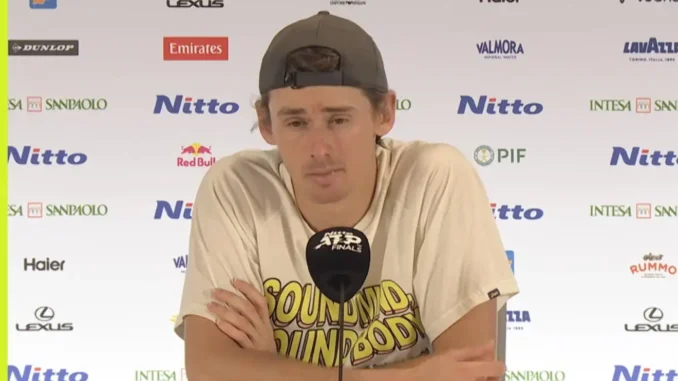
It was apparent, even before Alex de Minaur uttered a single word at his post-match press conference, that he shouldn’t have been sitting there—facing the glare of cameras and the pointed questions of the media—so soon after enduring one of the most agonizing defeats of his career. The tension in the room said it all. His shoulders were tight, his eyes distant, as if still replaying the final, fateful points in his head.
Only minutes earlier, De Minaur had stood on the brink of what could have been a breakthrough victory—his first-ever win at the ATP Finals. Yet, in a painfully familiar twist, triumph slipped through his fingers. Once again, the Australian found himself grappling with the cruel margin that separates glory from regret, and once again, he fell just short against a top-10 opponent.
For those who have followed his rise, De Minaur’s story is not one of failure but of relentless persistence. He has forged a career defined by heart, speed, and a never-say-die attitude that has earned him respect across the tour. In recent years, his steady improvement has carried him into the sport’s upper tier, a place reserved for the elite. Yet, somewhere along the climb, he seems to have hit an invisible barrier—one that keeps him just shy of breaking through against the very best in men’s tennis.
The latest chapter of this ongoing struggle played out under the lights on Tuesday night. De Minaur had maneuvered himself into a commanding position against Italy’s Lorenzo Musetti in their round-robin clash. The match had been a tense, seesaw battle—long rallies, sudden momentum shifts, both men straining for control. But in the deciding set, De Minaur appeared to have found his rhythm. At 5-4, serving for the match, the finish line was in sight. The crowd could feel it.
And then, just as quickly, it all unraveled. A couple of tentative serves, a mistimed forehand, and a flash of nerves gave Musetti an opening. De Minaur’s grip on the match loosened, and before anyone could quite process it, the Italian had wrestled back the momentum. The Australian, who had looked moments away from victory, was suddenly staring down defeat. When the final point was lost, he stood motionless for a moment—his racket dangling at his side, disbelief written across his face.

The pattern has become painfully familiar. Outside of the Laver Cup, De Minaur has now endured sixteen consecutive losses to players ranked inside the world’s top ten. Sixteen. For a player of his caliber—one who so often puts himself in winning positions—it’s a statistic that feels cruelly disproportionate. These aren’t matches where he’s been outclassed from the start. More often than not, he’s been right there, within touching distance of victory, only for something—hesitation, fatigue, a flicker of self-doubt—to intervene at the worst possible moment.
And yet, what makes De Minaur such a compelling figure is precisely this tension between triumph and heartbreak. His career is a testament to perseverance in a sport that rewards ruthlessness. He continues to show up, to fight, to believe that the next time will be different. His consistency has made him a fixture among the game’s top 20, but the question that now looms over him is whether he can take that next step—to not just compete with the best, but to beat them.
At the press conference, as flashes popped and questions were thrown his way, De Minaur chose his words carefully. There was no bitterness, only the faint trace of weariness. He spoke about learning from the loss, about building for next season, about staying positive. But behind the composure, there lingered a sense of quiet frustration—a feeling that he knows how close he’s come, and how heavy it’s beginning to feel to always come up just short.
For now, the ceiling remains. But for Alex de Minaur, a player built on grit and resolve, there’s little doubt that he’ll keep hammering at it—one swing, one point, one heartbreak at a time.
Leave a Reply